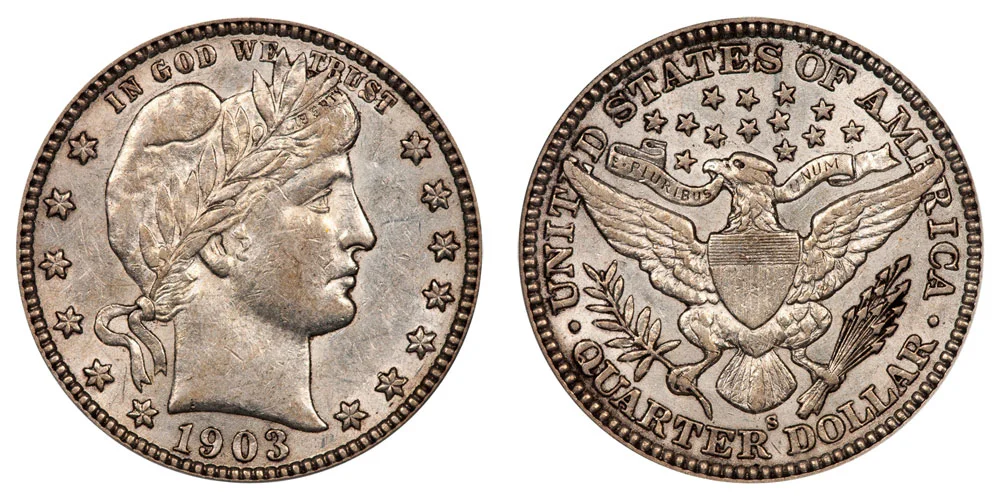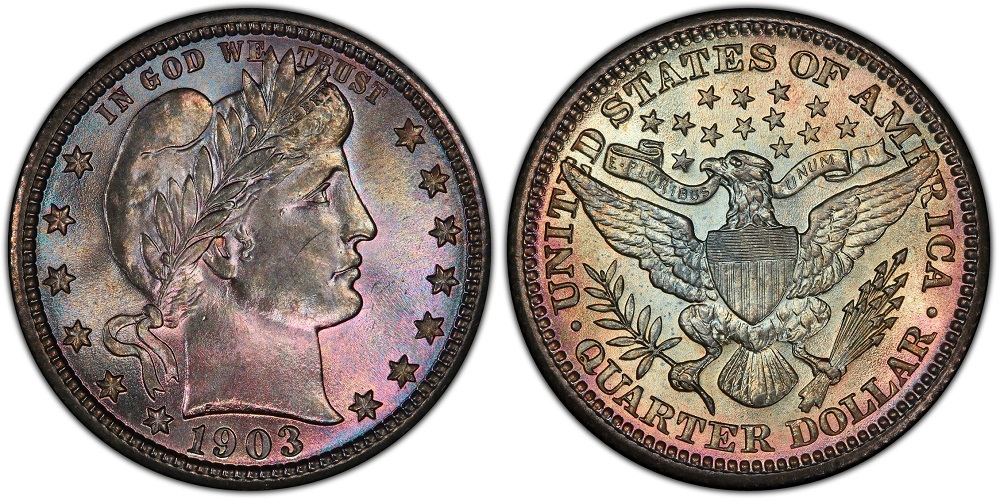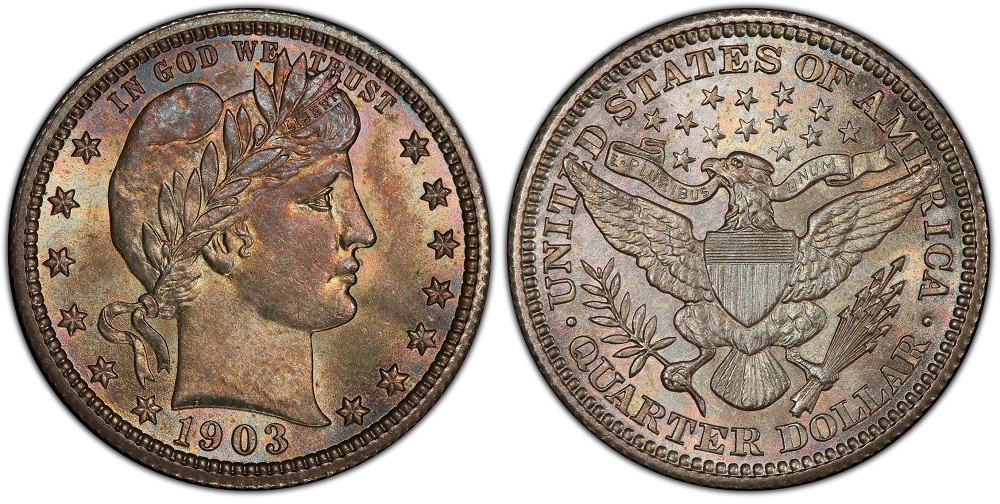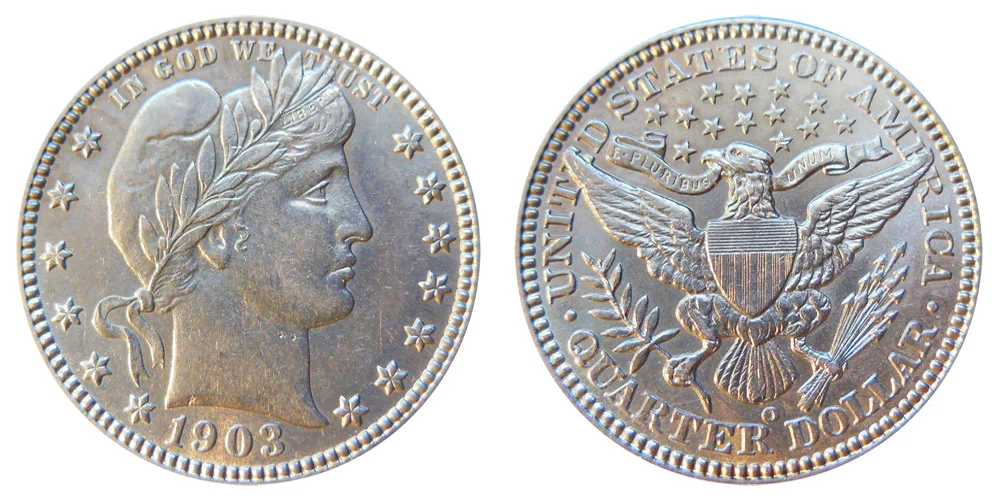
A gem-grade 1903-S Barber quarter realized $37,375 at Heritage Auctions in 2009 — thousands of times face value. Most worn examples are worth $19–$34, but the right mint mark or error can change everything. This free tool does the math for you.
Select your coin's mint mark, condition, and any known errors, then hit Calculate for an instant value estimate.
If you're not yet sure what mint mark or condition your coin has, there's a 1903 Quarter Coin Value Checker online tool that lets you upload a photo and get an instant identification before coming back here.
Describe what you see on your coin in plain language and our analyzer will match it to known 1903 Barber quarter varieties.
It takes less than 20 seconds — just pick your mint mark, condition, and any errors you see.
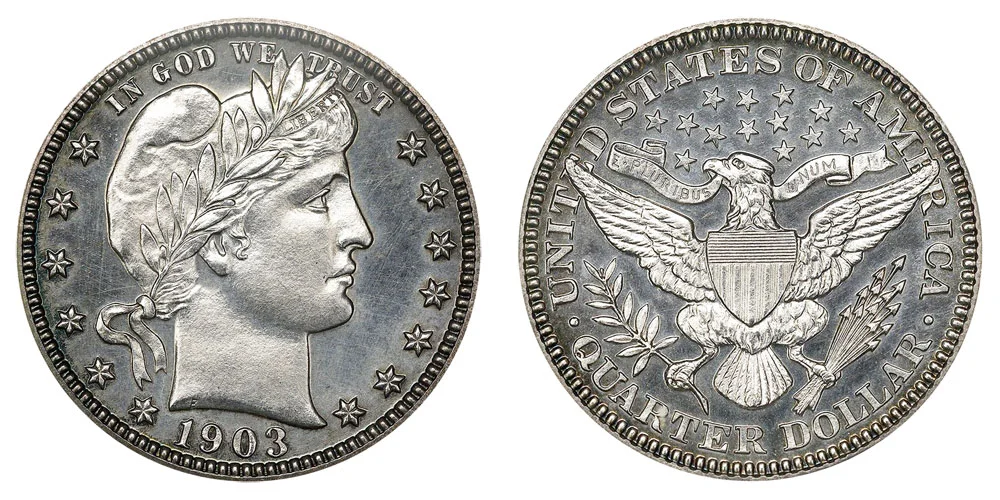
Get My Value Estimate →The 1903-S is the scarcest business strike of the year. Use this visual comparison and checklist to see if your coin matches the key diagnostic markers.
The table below summarizes estimated values across all 1903 Barber quarter varieties and major condition grades. For a detailed step-by-step 1903 quarter identification breakdown with illustrated grading examples, visit this complete Barber quarter reference guide. Highlighted rows indicate the most sought-after issues. Values reflect recent auction and dealer data; actual realized prices vary.
| Variety | Good (G4-6) | Fine (F12-15) | AU (AU50-58) | MS60-63 | Gem MS64+ |
|---|---|---|---|---|---|
| 1903 Philadelphia | $19 – $32 | $28 – $55 | $150 – $280 | $340 – $700 | $700 – $3,910 |
| 1903-O New Orleans | $22 – $32 | $48 – $59 | $260 – $460 | $550 – $1,200 | $1,200 – $32,900+ |
| ⭐ 1903-S San Francisco | $34 – $56 | $56 – $82 | $290 – $640 | $750 – $2,500 | $2,500 – $37,375+ |
| 1903 Proof (Philadelphia) | — | — | — | $480 – $1,500 | $1,500 – $11,500 |
| 🔴 1903 Proof DCAM | — | — | — | $4,740 – $10,000 | $10,000 – $40,800+ |
⭐ = signature variety (1903-S) · 🔴 = rarest/highest-value type · Values are estimates; consult PCGS Price Guide for current data.
📱 CoinHix is a handy on-the-go tool to cross-check your coin's value estimate against live market data — a coin identifier and value app.
Jump to any section of this guide:
Not every 1903 Barber quarter is equal. Beyond the three mint-mark varieties, a small number of documented minting errors and die varieties have been confirmed across the 1903 issues. These stem from the hand-punching process used to apply dates to individual working dies at each branch mint before 1909. The five varieties below range from modest premiums to significant collector finds — each with its own visual fingerprint and market premium.
MOST FAMOUS
$55 – $300+
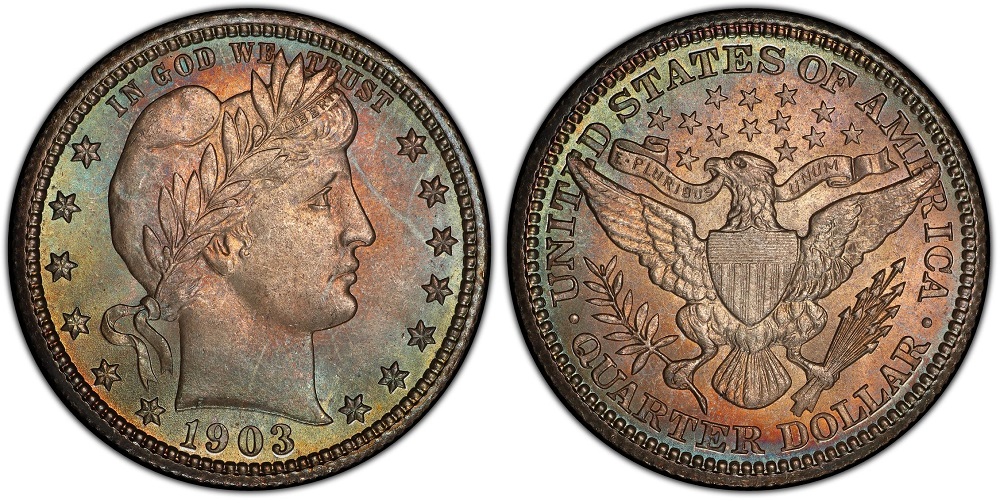
The misplaced date on the 1903-O Barber quarter is among the most discussed die variety of this year. It occurred at the New Orleans Mint when a working die received an errant punch during the hand-application of the date — one or more digits landed partially onto the denticle area of the die, too close to the inner rim.
On the finished coin, the misplacement appears as partial digit impressions crowding into the denticle zone along the lower portion of the date field. Under a 5× to 10× loupe, the displaced digit images are most obvious near the "3" or the "0" in 1903, where the lower serif appears to merge with or overlap the denticles. The cleaner and higher the grade, the more visually dramatic the displacement becomes.
Collectors pay a meaningful premium for a boldly visible MPD in a well-preserved coin. The premium grows significantly once the coin is in VF or above, as circulated wear tends to flatten the delicate secondary impressions. This variety is catalogued in the Barber Coin Collectors' Society literature and is a recognized find for specialists who work through New Orleans-mint material from this era.
BEST KEPT SECRET
$35 – $150+
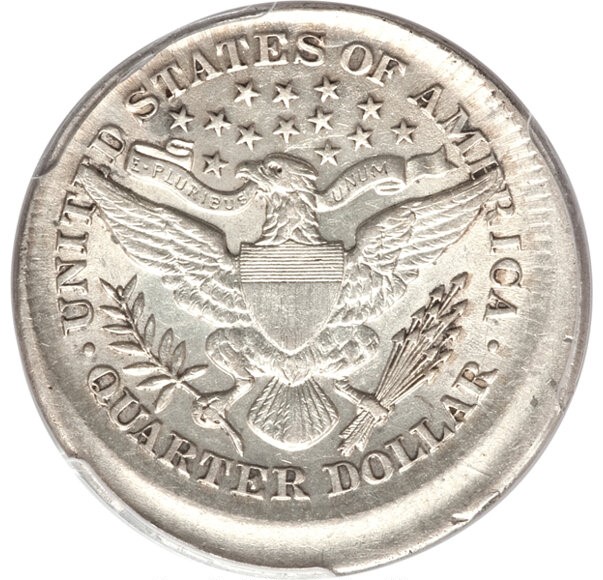
A repunched date (RPD) occurs when the date was punched into a working die more than once at a slightly different angle or position, leaving a secondary "ghost" impression alongside the primary digits. Before 1909, dates on Barber coinage were applied to individual working dies by hand using a hub punch — making minor misalignments a natural byproduct of the process.
On 1903 quarter RPD examples, the doubling appears most often as a faint shadow or secondary outline on one or more numerals. The "1903/1903, RPD-S" variety — where the secondary punch is slightly to the south of the primary — is listed in Barber Coin Collectors' Society survey data. Under magnification, check each digit carefully; a well-defined RPD will show a clear secondary serif or digit edge offset from the primary strike. Fine or better circulated examples with bold repunching show the effect most clearly.
While the premium for an RPD variety is more modest than an MPD on the same date, sharp examples in higher circulated grades still command collector attention. The variety is most valued when the repunching is visible at 5× rather than requiring 10× or higher magnification to confirm, as bold diagnostics make auction descriptions compelling to specialist buyers.
MOST DRAMATIC
$150 – $500+
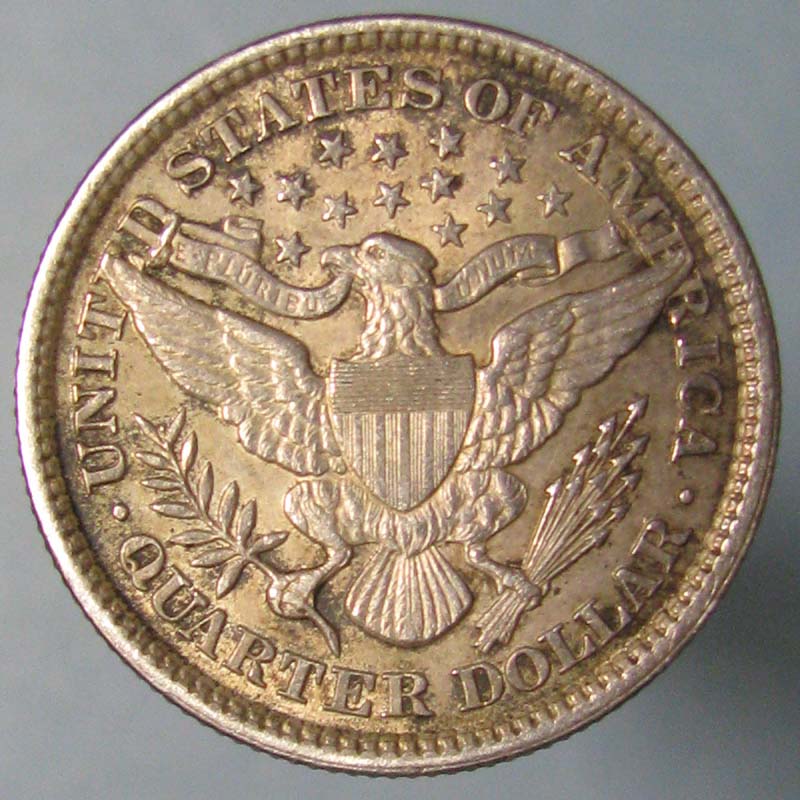
An off-center strike occurs when the planchet is not properly seated between the dies at the moment of strike, causing the design to be impressed onto only part of the blank. The result is a coin where Liberty's portrait and the eagle design appear shifted toward one side, with a corresponding blank crescent of plain planchet metal visible on the opposite edge.
On 1903 Barber quarters, off-center strikes are genuine rarities — quality control at the Philadelphia Mint was generally high, but these errors slip through at any mint occasionally. The most desirable off-center examples show a 10–50% offset while still retaining a fully readable date. An off-center strike that obliterates the date is worth considerably less, as the year and mint mark are necessary for collector attribution. Look for the crescent of blank planchet on one side and the corresponding design crowding on the other.
Collector demand for off-center Barber quarters is strong because the series itself is widely collected and the visual drama of a shifted design on a classic silver coin is immediately apparent. A well-centered partial shift of 20–30% on a mid-grade circulated example can bring $150 or more above the standard value, while dramatic 40–50% strikes in Choice condition can push past $500 depending on date legibility and the strike's aesthetic impact.
MOST COLLECTIBLE
$30 – $200+
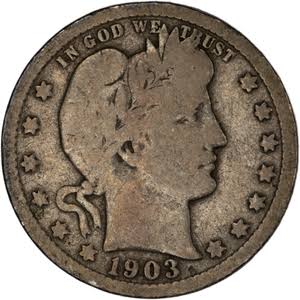
Die cracks form when a working die develops fractures under the repeated stress of striking planchets. The metal of the die at the crack point is slightly raised, and each subsequent coin struck from that damaged die picks up a corresponding raised line — called a die crack — on its surface. When a piece of the die breaks away entirely at the rim, the resulting void creates a cud: a blob of raised, featureless metal at the coin's edge where the design should be.
On 1903 Barber quarters, die cracks are among the most frequently encountered die-state varieties, particularly on Philadelphia-mint coins where high-volume production stressed the dies more rapidly. Minor hairline die cracks add little premium, but a bold crack traversing Liberty's portrait, crossing from rim to rim, or — most dramatically — a rim cud, are genuine collector pieces. The raised line is always on the coin (not incuse), which distinguishes a die crack from a post-mint scratch.
A major cud on a Barber quarter — where a rim segment is entirely replaced by a blob of raised silver — is a clear minting error that grading services will note on the holder label. These typically carry a premium of $30–$200 over the base value of the coin depending on the size of the cud, its location (over the portrait is most dramatic), and the overall grade of the coin. Specialist error collectors actively seek dramatic die-crack examples across the entire Barber series.
PLANCHET RARITY
$30 – $100+
A lamination error occurs when impurities or gas pockets within the silver planchet cause layers of metal to separate, peel, or flake away from the coin's surface. In 1903, silver planchets were produced from 90% silver and 10% copper alloy strip rolled at contracted refineries. Occasionally, impurities in the alloy or rolling imperfections created weak planes within the metal that would separate during or after the striking process.
On a 1903 Barber quarter with a lamination error, the affected area appears as a lifted, peeled, or missing patch of surface metal, often with a different texture or color than the surrounding original surface. The remaining underlayer may show a lighter silver tone or a rough texture where the upper metal has separated. Small laminations covering a few millimeters are the most common form; large, dramatic peels affecting a significant portion of the portrait or eagle design are considerably rarer.
Lamination errors are considered genuine mint errors and will be attributed by PCGS and NGC as long as the separation occurred before or during striking — not from post-mint damage or corrosion. The premium over base value depends heavily on the size and visual impact of the lamination. A small edge lamination might add $10–$30; a large obverse lamination covering Liberty's cheek or the eagle's breast can push the premium to $100 or more, especially in higher circulated grades where the coin would otherwise be quite presentable.
Run the calculator to see what your specific mint mark, condition, and error combination is worth right now.
Calculate My Error Coin Value →
Three mints struck 1903 Barber quarters. Philadelphia produced the most coins; San Francisco struck the fewest and its output commands the highest premiums today. Note that survival rates in gem condition are low across all three issues — the coins circulated heavily in commerce for decades before collector interest increased.
| Mint | Mint Mark | Business Strike Mintage | Proof Mintage | Notes |
|---|---|---|---|---|
| Philadelphia | None | 9,669,309 | 755 | Most common issue; proofs only at Philadelphia |
| New Orleans | O | 3,500,000 | — | Often softly struck; gem examples very scarce |
| San Francisco | S | 1,036,000 | — | Scarcest business strike; highest gem premiums |
| Total | 14,205,309 | 755 | ||
The portrait is mostly flat and worn smooth. In Good grade, the LIBERTY headband letters are largely obliterated. In Fine, at least 3–5 letters of LIBERTY are visible. The rim is complete. Most 1903 quarters encountered in pocket change will fall here. Worth $19–$82 depending on mint.
All 7 letters of LIBERTY are clear in VF. In XF, the hair above Liberty's forehead begins to show detail. In AU, only the very highest points show friction — the cheekbone and eagle's breast. Significant mint luster may remain in protected areas. Worth $68–$640 depending on mint.
No wear anywhere on the design. Look for cartwheel mint luster under a single light source. Contact marks and bag abrasions are acceptable at MS60–MS62. The Philadelphia strike tends to be sharper than New Orleans issues, which often exhibit soft eagle claws. Worth $340–$2,500 depending on mint.
Sharp strike, few or no contact marks, full mint luster. MS65 examples are exceptional — particularly for the 1903-S and 1903-O, where gem survivors are rare. The Sheldon scale goes to MS70, but no known 1903 quarter has been graded above MS67. Gem coins are worth thousands; an MS66+ 1903-S is worth tens of thousands.
🔬 CoinHix can help you match your coin's condition to graded reference examples for a fast side-by-side comparison — a coin identifier and value app.
The best venue depends on your coin's grade and type. A heavily worn $25 coin sells differently than a gem 1903-S worth thousands.
Best for gem-grade examples (MS63 and above), rare proof issues, and error coins. Heritage has set the auction record for the 1903-S, 1903-O, and 1903 Philadelphia. They attract serious collector bidders who drive prices to full market value. Seller's commission applies.
Ideal for mid-grade circulated examples ($20–$300 range). You reach a large buyer pool. Check recent sold prices for 1903 Barber quarters on eBay before listing to price competitively. Use high-resolution photos of both sides and mention the LIBERTY letter count in your listing.
Quick and convenient for worn or common examples. Dealers will buy at wholesale (typically 50–70% of retail), so this is best when convenience matters more than maximum price. Bring multiple coins — dealers prefer buying a collection over a single coin.
Good for mid-range coins with a known grade. Sellers deal directly with collectors — no buyer's premium. Requires a posting history and feedback. Best for coins in the $30–$200 range where the overhead of a full auction isn't warranted.
A 1903 Barber quarter's value depends on the mint mark and condition. Heavily worn Philadelphia examples start around $19–$32 in Good grade, while Mint State coins range from roughly $240 to over $3,900 for the Philadelphia issue. The 1903-S is the most valuable business strike, with auction records exceeding $37,000 in gem Mint State. Even a worn example retains silver melt value of roughly $13–$14.
Among business strikes, the 1903-S from the San Francisco Mint is the rarest with a mintage of only 1,036,000 — the lowest of the three 1903 issues. In gem Mint State grades (MS65 and above) it becomes exceptionally scarce. Among all 1903 quarter types, the Proof DCAM version is the ultimate rarity with only 755 proofs struck, and a PR68DCAM sold for $40,800 at Heritage Auctions in December 2024.
The mint mark on a 1903 Barber quarter is located on the reverse (eagle side) of the coin, positioned just above the text 'QUARTER DOLLAR' and directly below the eagle's tail feathers. An 'O' indicates New Orleans, an 'S' indicates San Francisco, and no mint mark means the coin was struck at Philadelphia. The letter is relatively large and easy to read with the naked eye.
Yes. All 1903 Barber quarters are composed of 90% silver and 10% copper. Each coin weighs 6.25 grams and contains 0.18084 troy ounces of pure silver. At current silver prices, even a heavily worn example retains a melt value of approximately $13–$14. Never clean a silver Barber quarter, as this can dramatically reduce its collector premium.
The auction record for the 1903-S Barber quarter is $37,375, achieved by an MS67-graded example sold at Heritage Auctions in July 2009. This is the highest result for any 1903 business-strike quarter. The 1903-O holds the second-highest record at $32,900 for an MS67 example sold at Heritage Auctions in May 2015 during the famous Gene Gardner Collection sale.
Start by reading the headband: a coin with all seven letters of LIBERTY clearly visible is at least Fine grade. In Good condition, the letters are mostly worn smooth. Uncirculated coins show full mint luster with no wear on Liberty's hair above the forehead or the eagle's breast feathers. Key wear points are the high hair curls above the forehead, the cheekbone, and the eagle's wing and neck feathers on the reverse.
Documented errors on 1903 quarters include the 1903-O Misplaced Date (date digits punched too close to the rim denticles), the 1903 Repunched Date (ghost outline of a secondary date impression), off-center strikes (design shifted off the planchet), die cracks and cuds (raised metal lines from die fractures), and lamination errors (surface flaking from impure planchet stock). Each can add a collector premium over standard values.
Three mints produced 1903 Barber quarters. Philadelphia struck 9,669,309 business-strike coins plus 755 collector proofs. New Orleans struck 3,500,000. San Francisco struck 1,036,000, making it the scarcest issue. The combined business-strike total across all three mints was approximately 14,205,309 coins. The low San Francisco mintage directly explains why gem-grade 1903-S quarters command such high premiums today.
A 1903-O Barber quarter in Good condition is worth approximately $22–$32. In Fine grade, values rise to around $48–$59. About Uncirculated examples can bring $260–$460, and Mint State coins range from roughly $550 upward. In the top gem grades, the 1903-O is extremely rare — the finest known MS67 example sold for $32,900 at Heritage Auctions in May 2015 from the Gene Gardner Collection.
No — never clean a Barber quarter. Even light cleaning with household products removes original mint luster and creates microscopic surface scratches that grading services classify as 'cleaned,' dramatically reducing value and making the coin ungradeable in its true condition. A 'problem-free' lightly worn example is always worth more than an artificially brightened one. Original surface, even with toning or minor spotting, is preferred by collectors and grading services alike.
Use our free calculator — pick your mint mark, condition, and any errors in under a minute.
Check My 1903 Quarter Value →